Dealing with Sin

The concept of sin for most Catholics is essentially identified with going against the rules set out in the Bible, especially in the ten commandments. And then in today’s Gospel we have Jesus coming and adding to those rules by interpreting many of them even more stringently with the phrase, ’You have heard that it was said….But I say to you’’
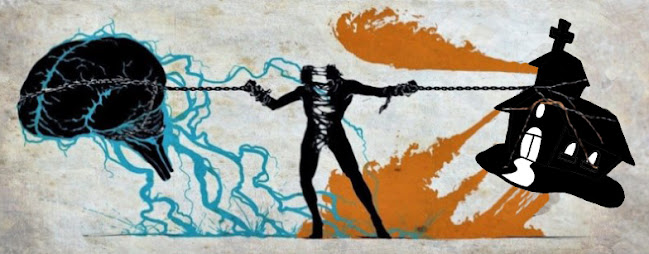
These many rules that Christians, especially Catholics who have the additional burden of Church rules, seem to have to follow, have given rise to a frequently voiced criticism of Christianity as a religion that encourages its adherents to feel guilty, and ‘Catholic guilt’ has even become a comic trope in American pop culture. The latter is generally described as an unhealthy and scrupulous sense of remorse, that is said to be fostered in Catholics right from the time they are children and which retains its hold over them into their adult lives. And thinkers like Nietzsche, Voltaire and Richard Dawkins, are some of those who have criticized Christianity for its alleged focus on our unworthiness/sinfulness.
I have already spoken of about how the idea of God enacting vengeance on those who did not follow his rules has reinforced this narrative of guilt (Vengeance is mine) and also of how the commandments are only meant to help one achieve one’s full potential (Does being good take away from joy).
So today I would like to talk about how some other religions deal with wrongdoing in general - and then see if there is any insight we can get from them, to add value to what our Christian concept of sin/wrongdoing offers us, - and more importantly on how we are helped to heal in those different systems.
Having said that we must understand that the concept of sin or wrongdoing seems to be an important concept in all religions, not for the sake of guilt tripping, but rather because it is only through acceptance of wrongdoing that we can truly start to improve. In fact many secular ideologies, while rejecting the idea of wrongdoing as sin, use many of the practices of Catholicism in working towards the healing of broken persons. Thus in secular fields like psychology and psychotherapy, people who are particularly disturbed are helped to grow into health by talking with a counsellor (a secular version of Catholic confession? ), and like in confession, the acknowledgement of one’s own failures, and taking responsibility for them is considered as a step towards healing. Sometimes, as in Alcoholics Anonymous, this even leads to the need to offer an apology and/or restitution of some sort, which can be seen as a secular equivalent of the penance imposed in the Catholic confessional.
Now,if we move on to religions that come under the influence of Hinduism (including Buddhism and Jainism in particular) and their secular equivalents as found in various non-God related meditation practices (e.g Vipassana, TM or tanscendental meditation, Tai-chi etc), we are brought face to face with quite a different understanding of ‘wrongdoing’ and how to set it right. In this approach to ‘wrongdoing’ or evil done by us, the paradigm is not so much that sin involves acts of disobedience or rebellion, but that it is the result of confusion or misunderstanding, caused by ignorance (‘avidya’)'. This avidya is present because humans are under an illusion about the truth of reality, and of self. Healing then takes place through awakening or enlightenment, where one realizes that one’s self is actually one with all of Reality (‘aham brahmasmi’, which means I AND THE ULTIMATE ARE ONE, or ‘tat tvam asi’ which means THAT which you worship, YOU ARE). And this awakening is often achieved through an interior journey - a journey that can be traversed through intense internal meditative practices (exemplified in the founder of Buddhism sitting under the BODHI tree), or through controlled intentional breathing and actions (as in Yoga or Tai Chi).
Therefore, it may be said that sin or wrongdoing in the Abrahamanic faiths (Judaism, Christianity and Islam) tend to focus on the relational aspect of our lives, focusing on how we sin by disobeying God and harming our neighbour, while Indic faiths seem to focus on the internal realization of the truth of our lives. This would also perhaps explain why among many ‘westerners’, specially those who are tired of the burden of guilt that seems central to the various Abrahamanic religions, there is a fascination with Indian and Far Eastern approaches to healing, for this diagnosis of our wrongdoing says that healing leading to ‘moksha’ (what the Abrahamanic religions call ‘salvation’) can be achieved, not by constantly trying to appease a Judge God, but through practices that help one realize one’s essential truth.
Though these two approaches to our broken human condition may seem quite distinct from each other, we may want to consider whether perhaps these are not totally opposed to each other. For instance, in Christianity, sin is often ignorance (which is why Jesus prays for his persecutors, 'Father forgive them for they know not what they do'). On the other hand, in the Indic traditions, karma is not morally neutral, and ignorance is willfully sustained by desire, habit and choice. Thus ‘knowing/enlightenment’ and ‘willing/action’ seem to be intertwined. This would explain why while enlightenment in Buddhism is indeed the goal, the Buddha teaches that the road to this enlightenment is to be found on the Eight-fold path - which path includes Right Speech, Right Action, Right Intention etc
In understanding SIN then, can we as Christians in today’s world, where we have come to see the value of other religious approaches, bring some of these other insights to enlighten us. First, we can take a cue from Jesus who expanded on the relational aspect of sin, by teaching that we do not sin only if we go much beyond the Mosaic Ten Commandments - when he taught that it is not enough that we do not physically harm our neighbour, but that we do not sin only when we eschew all kinds of violence, even in thought and word, against our neighbour.
And if we bring in the Indic insight into wrongdoing, we can perhaps further reflect on whether our wrongdoing is oftentimes not bad will, but our natural evolutionary instinct to do whatever helps us ‘survive’ or ‘win’, an instinct that is grounded on a delusion, that makes us unable to see the truth that lies at our deepest selves. And what is this truth we are not able to see - just this, that at our deepest selves we are intricately and intimately ONE, both with our neighbour and with Ultimate Reality, and harming our neighbour in any way is actually a harming of our very selves and a negation of our one-ness even with Ultimate Reality. And so, challenging the ‘survival of the fittest’ principle of evolutionary theory which seems to guide how most of us live our lives, what true enlightenment, the overcoming of ignorance, teaches us is that, in order to survive, we must all survive; in order to grow and flourish, we all must grow and flourish; in order to become truly happy, we all must become happy. I AM BECAUSE WE ARE. That brings us full circle to the Jesus insight that love of neighbour is the only way to show our love of God, for, after all, we are all ONE : Truly, I tell you, just as you did it to the least of these my brothers and sisters of mine, you did it to me (Mathew 25: 40)
First Reading: Sirach 15: 15-20
If you choose, you can keep the commandments,
and to act faithfully is a matter of your choice.
He has placed before you fire and water;
stretch out your hand for whichever you choose.
Before each person are life and death,
and whichever one chooses will be given.
For great is the wisdom of the Lord;
he is mighty in power and sees everything;
his eyes are on those who fear him,
and he knows every human action.
He has not commanded anyone to be ungodly,
and he has not given anyone permission to sin.
Second Reading: 1 Corinthians 2: 6-10
Yet among the mature we do speak wisdom, though it is not a wisdom of this age or of the rulers of this age, who are being destroyed. But we speak God’s wisdom, a hidden mystery, which God decreed before the ages for our glory and which none of the rulers of this age understood, for if they had, they would not have crucified the Lord of glory. But, as it is written,
“What no eye has seen, nor ear heard,
nor the human heart conceived,
what God has prepared for those who love him”—
God has revealed to us through the Spirit, for the Spirit searches everything, even the depths of God.
Gospel: Mathew 5: 17-37
“Do not think that I have come to abolish the Law or the Prophets; I have come not to abolish but to fulfill. For truly I tell you, until heaven and earth pass away, not one letter, not one stroke of a letter, will pass from the law until all is accomplished. Therefore, whoever breaks one of the least of these commandments and teaches others to do the same will be called least in the kingdom of heaven, but whoever does them and teaches them will be called great in the kingdom of heaven. For I tell you, unless your righteousness exceeds that of the scribes and Pharisees, you will never enter the kingdom of heaven.
“You have heard that it was said to those of ancient times, ‘You shall not murder,’ and ‘whoever murders shall be liable to judgment.’ But I say to you that if you are angry with a brother or sister, you will be liable to judgment, and if you insult a brother or sister, you will be liable to the council, and if you say, ‘You fool,’ you will be liable to the hell of fire. So when you are offering your gift at the altar, if you remember that your brother or sister has something against you, leave your gift there before the altar and go; first be reconciled to your brother or sister, and then come and offer your gift. Come to terms quickly with your accuser while you are on the way to court with him, or your accuser may hand you over to the judge and the judge to the guard, and you will be thrown into prison. Truly I tell you, you will never get out until you have paid the last penny.
“You have heard that it was said, ‘You shall not commit adultery.’ But I say to you that everyone who looks at a woman with lust has already committed adultery with her in his heart. If your right eye causes you to sin, tear it out and throw it away; it is better for you to lose one of your members than for your whole body to be thrown into hell. And if your right hand causes you to sin, cut it off and throw it away; it is better for you to lose one of your members than for your whole body to go into hell.
“It was also said, ‘Whoever divorces his wife, let him give her a certificate of divorce.’ But I say to you that anyone who divorces his wife, except on the ground of sexual immorality, causes her to commit adultery, and whoever marries a divorced woman commits adultery.
“Again, you have heard that it was said to those of ancient times, ‘You shall not swear falsely, but carry out the vows you have made to the Lord.’ But I say to you: Do not swear at all, either by heaven, for it is the throne of God, or by the earth, for it is his footstool, or by Jerusalem, for it is the city of the great King. And do not swear by your head, for you cannot make one hair white or black. Let your word be ‘Yes, Yes’ or ‘No, No’; anything more than this comes from the evil one.

Comments
Post a Comment